
Continuous inkjet (CIJ) printers are a staple in the packaging industry, offering high-speed, non-contact marking and coding solutions. These printers are widely used for applying expiration dates, batch codes, and other critical information on products and packaging.
One of the reasons for this success is the vast selection of inks that have been developed for different packaging applications.
For general package coding applications, dye-based inks are usually the first choice.
Dye-based inks are the easiest to run on CIJ printers, and all printer manufacturers (as well as some third-party producers) have them in their product line.
These inks perform well in CIJ printers because the dye is completely dissolved in the ink’s solvent and will stay in solution for extended periods.
However, greater durability or opacity is needed for some applications – especially when printing on dark-colored substrates and when printing on some plastics.
That’s where pigment-based inks step in.
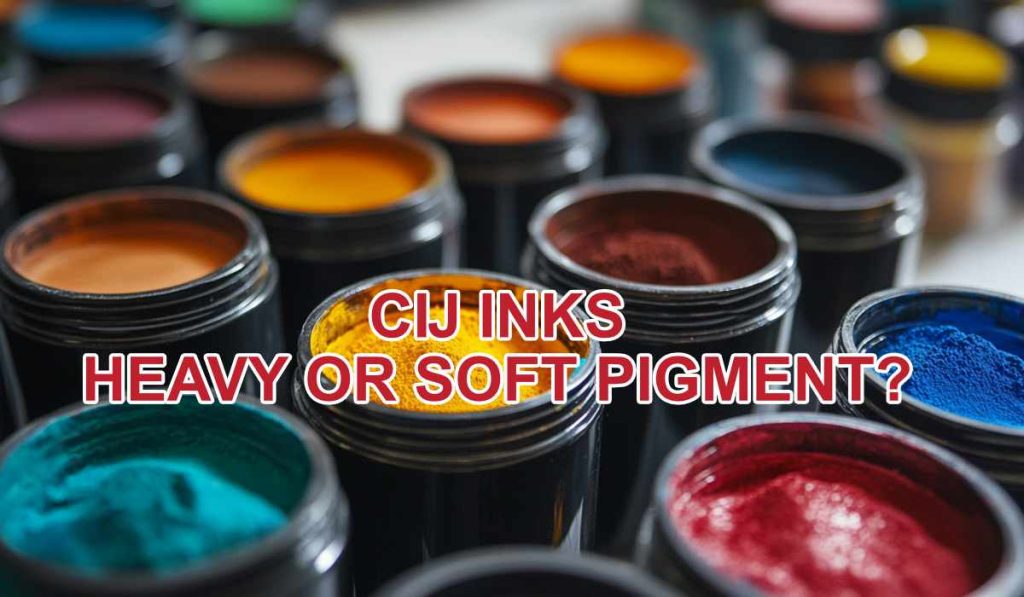
Pigmented or heavy pigment inks contain solid particles (pigments) suspended in a liquid carrier. These pigments are responsible for the ink’s color and increased opacity but are also prone to settling and clumping inside the printer – as well as having the potential to block the nozzle.
The Challenges of Heavy Pigment Inks in CIJ Printers
CIJ printers are designed to eject tiny droplets of ink through a high-pressure nozzle at extremely high speeds. This process requires the ink to maintain consistent viscosity and flow. Heavy pigment inks introduce several challenges that can disrupt this process:
Settling and Sedimentation
Heavy pigments tend to settle at the bottom of the ink reservoir over time, even with agitation systems. This results in inconsistent pigment distribution, leading to uneven print quality and potential nozzle blockages.
Nozzle Clogging
The larger particle size in heavy pigment inks increases the risk of clogging the printer’s micro nozzles. Frequent clogs require more maintenance, downtime, and cleaning cycles, reducing overall productivity.
Shear Forces
CIJ printers rely on high-pressure systems to break ink into droplets. The larger particles in heavy pigment inks can resist these forces, leading to improper droplet formation and poor print resolution.
Inconsistent Suspension Stability
Heavy pigment inks require continuous stirring or recirculation to keep pigments suspended. If the agitation system is insufficient or fails, the ink can separate, further complicating print consistency.
While pigment-based inks can produce high-quality, high-opacity prints (especially with white inks), the inherent difficulties of using them has to be taken into account.
Are Soft Pigment Inks the Solution?
Die-based inks run best on printers, but pigment inks are sometimes needed to get the best print results. Is there a formulation that offers the advantages of both?
Well, oft pigment inks are specifically engineered to address the challenges posed by CIJ printing environments. Here’s why they might be the answer in many cases::
Smaller Particle Size
The finer particles in soft pigment inks flow more smoothly through the printer’s system. They are less likely to settle or cause clogs, ensuring uninterrupted operation.
Enhanced Suspension Stability
Soft pigment inks remain stable in suspension for longer periods, reducing the need for aggressive stirring or recirculation. This stability ensures consistent print quality and reduces maintenance requirements.
When soft pigment inks are used in a CIJ printer set up for pigment inks, printer uptime performance can increase by up to 50%.
Improved Droplet Formation
With their smaller particle size, soft pigment inks respond better to CIJ printers’ high-pressure droplet formation process. This results in sharper, more precise codes and markings.
Lower Maintenance Requirements
Since soft pigment inks are less prone to clogging and settling, printers require less frequent cleaning and maintenance. This translates to higher uptime and lower operational costs.
Versatility Across Substrates
Soft pigment inks provide excellent adhesion and legibility on a wide range of substrates, from plastics and glass to metals and cartons, without the complications introduced by heavier pigments.
Not for Every Application
While soft pigment inks certainly help in many situations, there is one important issue to consider: white inks are only available in hard or heavy pigment formulations.
If you need to print on dark-colored material, it might be a good idea to use yellow ink to get a code that has good visibility.
Some ink manufacturers also produce inks in formulations that are a combination of both heavy and soft pigments.
Next Steps
If you are thinking of using CIJ print technology for coding dark-colored materials, be sure to speak with an OEM that has a lot of experience with this issue.
A good manufacturer will have a selection of printer hardware and ink formulations and will be able to advise you on the right solution for your specific applications.
More Info
Check out this datasheet from Videojet that covers die-based and both types of pigment inks.


